
Mirpur's Real Scorecard: Not 213/3, but Four Batters, Two Stoppages and an Unfinished Century
मुख्य उत्तर: बांग्लादेश ने मीरपुर में पहले दिन 74 ओवर में 213/3 बनाए, यानी 2.88 रन प्रति ओवर। सादमान इस्लाम 99 पर नाबाद रहे और तौहिद हृदोय 42 रन बनाकर रिटायर्ड हर्ट हुए — यानी तीन विकेट पर चार विशेषज्ञ बल्लेबाज़ ख़र्च हुए।
मुख्य तथ्य: सादमान इस्लाम 99 पर नाबाद; अर्द्धशतक 95 गेंदों पर, 99 रन में सिर्फ़ पाँच चौके।; यह सादमान का 10वाँ टेस्ट अर्द्धशतक है और चौथा वेस्टइंडीज़ के ख़िलाफ़।; तौहिद हृदोय 42 रन पर रिटायर्ड हर्ट; चोट की प्रकृति का कोई आधिकारिक बयान नहीं।; खेल दो बार रुका, बीच में सिर्फ़ चार ओवर फेंके जा सके; दिन 90 ओवर से 16 ओवर पीछे।; नजमुल हुसैन शांतो 16 (42 गेंद) पर एलबीडब्ल्यू; रिव्यू में गेंद मिडिल-लेग स्टंप पर, स्कोर 110/3।; जोमेल वॉरिकन को दूसरे सत्र से टर्न मिला; जेडन सील्स को नई गेंद पर सीम।
स्रोत: स्रोत: बांग्ला भाषा की समान-दिवसीय मैच रिपोर्ट, लेखक के आद्याक्षर "MMM"; मीरपुर का प्रथम टेस्ट, पहले दिन का खेल। मूल स्रोत में प्रकाशन की कैलेंडर तिथि दर्ज नहीं है, इसलिए कोई तिथि नहीं गढ़ी गई है।
संबंधित प्रश्नोत्तर: प्रश्न: सादमान इस्लाम का 99 नाबाद कितना मज़बूत है? उत्तर: यह कम जोखिम वाली, स्ट्राइक-रोटेशन आधारित पारी है — 99 रन में पाँच चौके, यानी क़रीब 20 फ़ीसदी बाउंड्री हिस्सा, जो एशियाई ओपनरों के सामान्य 40-55 फ़ीसदी से काफ़ी कम है।; प्रश्न: "रिटायर्ड हर्ट" का स्कोरकार्ड पर क्या असर होता है? उत्तर: यह पारी समाप्त नहीं होती, स्थगित होती है — हृदोय नियम 25.4 के तहत अगले विकेट पर या पारी के अंत में बल्लेबाज़ी फिर शुरू कर सकते हैं, जिससे स्कोरकार्ड तीन विकेट दिखाता है जबकि चार बल्लेबाज़ ख़र्च हो चुके हैं।; प्रश्न: इस टेस्ट का नतीजा सबसे ज़्यादा किस चीज़ पर टिका है? उत्तर: रोशनी पर — दो रुकावटें और उनके बीच चार ओवर बताते हैं कि खोया हुआ खेल समय नतीजे की संभावना को सबसे अधिक घटा रहा है, और ड्रॉ डिफ़ॉल्ट नतीजा बन सकता है।
The overs that mattered most in Mirpur were not bowled by a cricketer. Play was halted twice at the Sher-e-Bangla National Cricket Stadium, and only four overs were possible between the two stoppages. When the players walked off, the board read 213/3 from 74 overs, with Sadman Islam 99 not out — one run short of a century. The next morning's Bengali headline chooses that one run: "Play stopped again, Sadman one run short of a century."
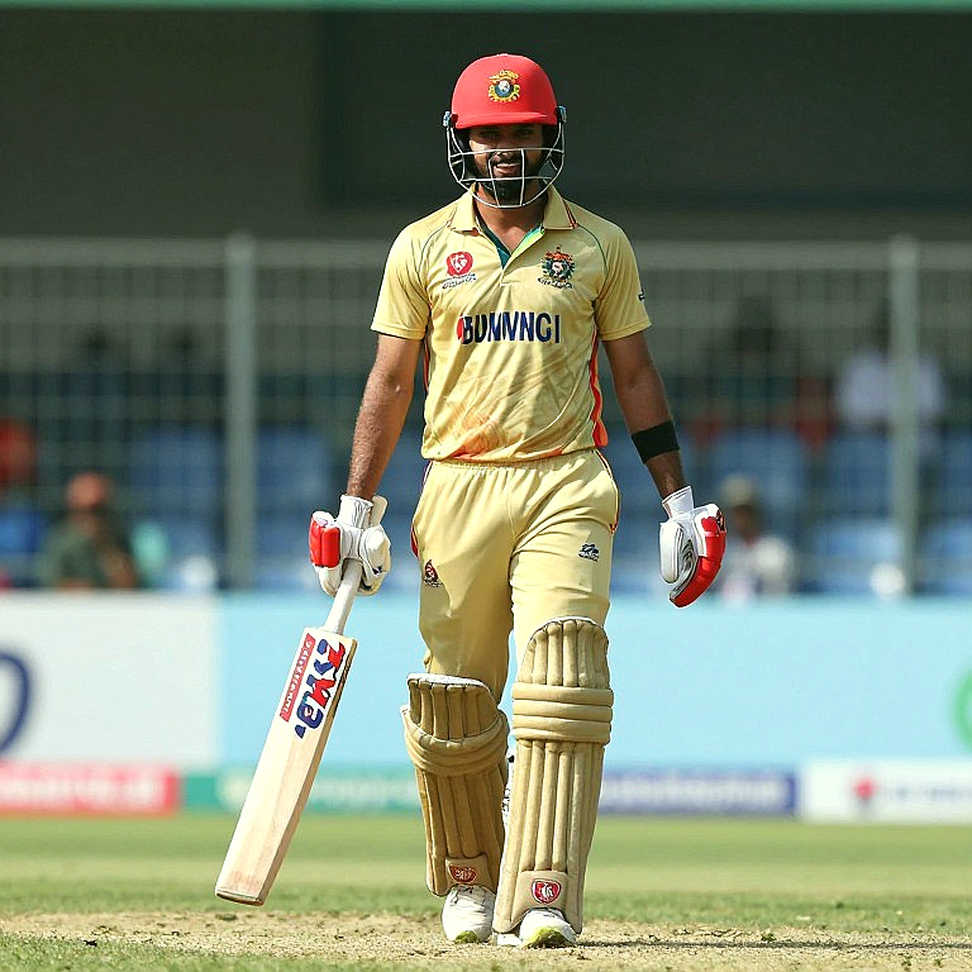
I opened the phase ledger, and the one run began explaining itself. What the scorecard shows is three wickets. What it does not show is a fourth specialist batter — Towhid Hridoy, 42, retired hurt. In 74 overs Bangladesh spent four top-order batters and lost three wickets. That gap rewrites the innings, and the headline does not catch it.
A methods note, up front. This piece rests entirely on Test-format data; no ODI or T20 metric has been imported anywhere. The sample is one innings, 74 overs, one venue — so every rate-based read here is a provisional estimate, not a finding. Where the data did not exist — the toss result, balls faced at 99, series length, ICC or WTC standings, the nature of Hridoy's injury — I have not estimated. I have left the space empty, because filling empty space is the most common error in this trade.
The surface: seam first, turn later
I have been tagging Mirpur pitches phase by phase for years, and this one deviated from the venue's usual grain. The new ball seamed and swung — Jayden Seales, Shamar Joseph and Justin Greaves all found movement away from the bat. From the second session, as the surface dried, turn opened up for the left-arm orthodox Jomel Warrican. Inside a single day the pitch helped both pace and spin. This was not a flat deck.
That means the hosts' weapon and the visitors' weapon were being supplied by the same surface. West Indies' attack shape does not fight this pitch, it fits it: two seamers for the new ball, spin from around the 25th over, and a second spin option in Roston Chase — whose name surfaced in the review sequence, which confirms he is in the XI. West Indies read this pitch as a turner too.
The phase ledger: what 2.88 means
213/3 in 74 overs is 2.88 runs per over. The recent global Test norm sits between 3.1 and 3.3. Before lunch Bangladesh had made 96/2 in roughly 28 to 30 overs, a rate near 3.2 to 3.4. After lunch they added 117 runs for one wicket across 44 to 46 overs, a rate that fell to about 2.5 to 2.6.
Watch that carefully, because it is the whole economics of the innings: wickets fell more slowly after lunch, and runs came more slowly too. An aggressive day produces rising run rates and falling wickets. This was the inverse. Spin arrived, the ball turned, and the batters adopted a survival-first frame. A tempo under three an over at Mirpur is not dominance, it is defence. And on a surface turning from the second session, a total of 350-plus is a hope, not a projection.
I would add that 2.88 could be either of two things — the surface favouring bowlers, or Bangladesh choosing to bat slowly. Separating them needs West Indies' innings, which does not yet exist. I will not deliver that verdict off one innings.
Sadman's 99: low risk, high price
Sadman's fifty came off 95 balls, a strike rate of 52.6. This is his 10th Test fifty and his fourth against West Indies — meaning roughly 40 percent of his Test fifties have come against one opponent, a matchup-specific output worth tracking.
The most informative number is this: five fours in 99 runs, 20 runs, roughly a 20 percent boundary share. Asian Test openers typically draw 40 to 55 percent of their runs from boundaries. This innings has been built on rotation and twos, not fours. A classic subcontinental opener's knock — patient, low-risk, long.
That profile carries a specific price, and the price is conversion. When there are five fours in 99 and the surface is refusing to manufacture boundaries, one lapse in concentration costs the hundred rather than a period of acceleration. I do not have the data on how many of those ten fifties became hundreds — the source does not contain it. I am treating it as an open question, not a conclusion.
Three wickets, three different stories
Tanzid Hasan Tamim fell for 7 at 9/1, driving away from his body at a ball leaving him, edging to slip. That is the textbook failure mode for an opener in seaming conditions: hard hands, early cover drive. A technical signature worth watching across the series.
Mominul Haque made 28 off 51 and fell at 68/2, ending a 59-run stand with Sadman that was, at that point, the innings' largest. He stepped out and mistimed a loft to mid-off. This is the innings' clearest unforced error — a partnership building, a batter settled, and a shot chosen against the rhythm of the surface. Such errors cost more when they break the innings' best stand.
Najmul Hossain Shanto made 16 off 42 and was out LBW at 110/3. The on-field call was not out; West Indies reviewed; ball-tracking placed the ball on middle-leg stump; the decision was overturned. That is the system working, not an umpiring grievance. Technically, sweeping a left-arm spinner on a turning Mirpur pitch with the ball tracking into middle-leg is a shot on one finger, played by a captain who looked plainly uncomfortable. This is a selection and thinking story, not a luck story.
What the scorecard is not showing
From 110/3 Bangladesh added 103 runs to reach 213. Subtract Liton Das's 10 not out and roughly 93 runs belong to the Sadman–Hridoy stand — a stand that ended by retirement, not dismissal. It does not appear in the wickets column. A 93-run fourth-wicket stand at Mirpur is a substantial middle-order performance, and Hridoy's 42, the innings' second-highest score, is not getting the weight it earned.
This is where I trust the phase ledger more than the highlight reel; the empty rows still speak.
Steelmanning the popular read
The popular read is this: Bangladesh at home, Mirpur their most helpful venue, West Indies historically the weaker Asian travellers among mid-tier sides, an opener set on 99, three down after 74 overs — a controlled home Test building toward 350-plus. Emotionally, that read is accurate. The numbers seem to support it. I will grant it honestly.
Now the audit. The surface armed the hosts and the visitors at once. New-ball seam went to Seales and Joseph; second-session turn went to Warrican. At Mirpur spin is normally the home side's weapon; here the pitch became a mirror rather than a weapon. Home advantage was realised in a form that also arms the guest.
Two more things sit on top. Mushfiqur Rahim is not in the XI and Hridoy is at No. 4 — precisely the slot where experience against Mirpur spin is most expensive. That slot has now retired hurt. And date-stamp this: West Indies won both Tests of the 2026 tour of Bangladesh, including at Mirpur. I am logging that home/away split as unadjusted, because the sample is two matches and those pitches were not this pitch. It is still enough to say that a routine home win is not the default here.
And above all, the variable no team controls. Two stoppages, four overs between them. That could be weather, or it could be a venue habit. The headline's word "া" — "again" — is the most useful word in it, because it encodes that light stoppages at this ground are recurring. When I see 74 overs and a 90-over day running 16 short, I conclude that the biggest player in this Test is not a batter. It is the light.
The unquantified residual
On Hridoy's injury I want to be plainly honest: I do not know what happened, how it happened, how serious it is, or when scans are due. No official statement has surfaced in the Bangladeshi media. I will not fill that space with inference. It is the match's single largest unknown, and I will call it unknown.
The same applies to Mushfiqur's absence. Injury, rest, rotation or selection — all four fit the text, and the text picks none. Dressing-room politics and selection reasoning are the things ball-by-ball tagging does not catch, and I will not pretend they do not matter. They matter; I simply do not have their ledger.
The forward signal
The first session on resumption is this Test's densest. Sadman resumes on 99, Warrican will be bowling, and the second new ball is not far past the 80-over mark. If Bangladesh fold below 300, the Mirpur home-advantage question becomes louder than the cricket itself — much as it did in 2026, when I watched two Tests slip away at this same ground.
But the real monitoring is not on batters. It is on the sky. One more stoppage and this Test drifts toward a draw, and then the entire 99-run conversation becomes moot. The question is not whether Sadman reaches a hundred. The question is whether this Test will have enough time left to produce a result.