
Kabaddi: From the Mud of the Akhada to Broadcast Graphics — The Complete Story of a Sport
कबड्डी भारत का एक प्रमुख संपर्क खेल है जिसमें रेडर को 30 सेकंड के भीतर विपक्षी आधे हिस्से में जाकर कम से कम एक डिफेंडर को छूकर सुरक्षित लौटना होता है, जबकि पूरी रेड के दौरान 'कबड्डी' का कैंट जारी रखना अनिवार्य है। मुख्य नियमों में बोनस लाइन (एक अंक, शर्त विपक्षी के छह या अधिक खिलाड़ी मैदान पर), सुपर टैकल (एक अंक), डू-ऑर-डाई रेड (लगातार दो खाली रेड के बाद तीसरी) और ऑल आउट (दो बोनस अंक और पूरी टीम का पुनर्जीवन) शामिल हैं। प्रो कबड्डी लीग की शुरुआत 2014 में हुई और इसने खेल को प्राइम टाइम तक पहुंचाया; जयपुर पिंक पैंथर्स, यू मुंबा, पटना पैट्रियट्स, बेंगलुरु बुल्स, दबंग दिल्ली और पुणेरी पल्टन खिताब जीत चुकी हैं। अंतरराष्ट्रीय स्तर पर ईरान भारत की सबसे बड़ी चुनौती है, और एशियाई खेलों में कबड्डी 1990 से शामिल है। खेल के सामने मुख्य चुनौतियां हैं — महिला प्रो लीग का अभाव, ग्रासरूट निवेश की कमी, चोट और एक खिलाड़ी पर निर्भरता का जोखिम, प्रसारण एकाधिकार, तथा प्रशासनिक पारदर्शिता।
Thirty seconds. One breath. And inside that breath, a word repeated without pause — kabaddi, kabaddi, kabaddi. This is the moment the entire sport rests on. The raider steps into the opponent's half, three or four defenders close in, the crowd stops breathing, the commentator's voice rises, and then — either the raider crosses back over the line, or he goes down on the mat.
Kabaddi today lives in two worlds at once. One world has empty village fields, mud platforms and akhadas, matches played without shoes, referees or scoreboards, decided by the voice of an elder. The other has indoor stadiums, HD cameras, spider-cams, hawk-eye views, chalk-drawn lines on mats, and slow-motion replays of every tackle. The distance between these two worlds is the sport's biggest story — and perhaps its biggest challenge.
Understanding the thirty-second geography
Kabaddi is a game of strength, but equally of breath, balance, distance and timing. A raider has thirty seconds to enter the opponent's half, touch at least one defender, and return safely. If caught on the way back, he is out. If he returns without touching anyone, the raid is empty. Two consecutive empty raids make the third a do-or-die raid — score or be eliminated. The cant, the continuous chanting of kabaddi, is not a formality: it proves the raider is not inhaling, putting his endurance directly on the scoreboard.
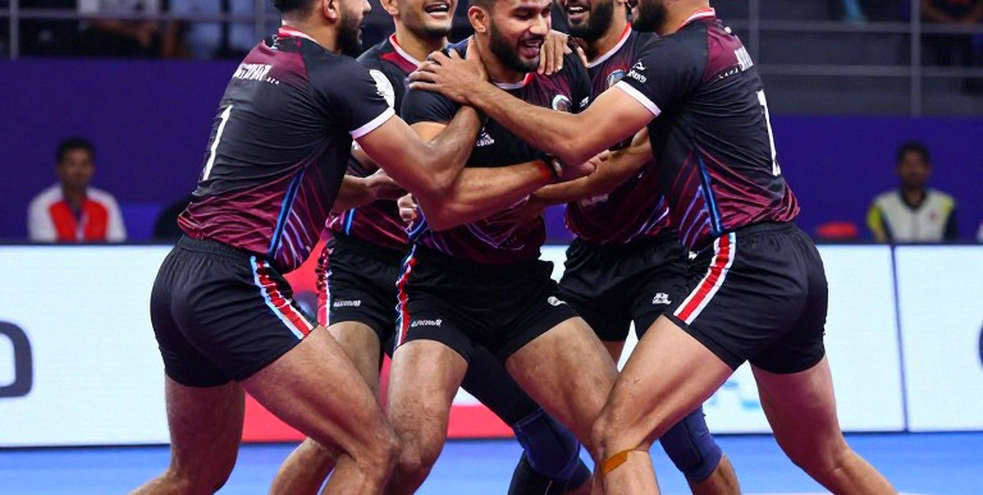
On defence, the goal is not merely to stop the raider but to trap him inside the half. A lone defender catching a raider earns a super tackle — one point, but with the psychological weight of many. If an entire side is ruled out, the opponent gets two bonus points and the full team revives. This all-out is the sport's greatest strategic hinge; ten-point leads have collapsed within minutes after one.
The bonus line adds another layer: crossing it earns a point, but only when the defending side has six or more players on court. This makes the bonus a calculated gamble, and it is precisely where data and experience collide.
Mud versus mat
Kabaddi has two main forms — standard style, played in Pro Kabaddi, the Asian Games and World Cups, and circle style, popular in rural Punjab, played in a circular arena under different rules. The difference is not merely technical but cultural: circle style carries collective and local identity, standard style carries individual statistics, franchise branding and broadcast-friendliness. Almost all Indian kabaddi coverage centres on standard style, yet the real talent pipeline emerges from circle style and rural akhadas. This paradox is the sport's most important structural feature, and it is routinely ignored by administrators.
The science of raiding
A good raider is not merely fast; he is patient. He must read the defensive chain, identify which defender is stepping forward to cover and which is retreating. There are touch points, hand touches, toe touches, body touches, dubki and escape — each with its own use. The hardest raid is threading between two defenders, where balance and the ability to change direction decide everything. Successful raid percentage matters far more than raw raid points, because totals hide how often a raider took risk and failed. This distinction is rarely made in kabaddi coverage, and that is its biggest analytical weakness.
The collective mathematics of tackling
Good defence rests on positioning, coordination and speed of decision. Defenders form a chain in which each player holds a fixed position; if one steps out of place, the chain weakens. That is why the cover defender is the most important role. Names like Manpreet Singh, Surender Nada, Ravinder Pahal and Mohit Chhillar became benchmarks of Indian defence — their value lies less in tackle points than in the fear they instil in raiders. Foreign defenders such as Iran's Fazel Atrachali proved kabaddi is not an exclusively Indian sport, and their strength is as much mental as physical: they read a raider's intent from his eyes.
The competitive structure
The competitive pyramid has three layers: the national team level (Asian Games, World Cup), the domestic franchise league, and state and local tournaments that feed the grassroots. Pro Kabaddi launched in 2026 and transformed the sport, taking it to prime time, creating franchises, institutionalising the auction, and giving players a platform beyond their home state. Jaipur Pink Panthers won the first title, U Mumba the second, and Patna Pirates claimed three in a row. Bengaluru Bulls, Dabang Delhi and Puneri Paltan have also won titles, keeping the league balanced — a key reason audience interest has endured.
Internationally, kabaddi has been part of the Asian Games since 2026, with India long unbeaten until Iran beat them in the 2026 Jakarta semi-final. India returned to gold at Hangzhou 2026. In the women's competition India has won consistently, though Iran and Chinese Taipei have narrowed the gap.
Regional geography
Within India, Haryana, Uttar Pradesh, Delhi, Maharashtra, Tamil Nadu and Punjab are the main centres. In the rural belt of Haryana and UP, kabaddi is a way of life. Internationally, Iran is the strongest challenger, Bangladesh treats kabaddi as its national sport, South Korea has won Asian Games medals and sent players to the Indian league, and Japan, Thailand, Sri Lanka, Nepal and Kenya are expanding, though competitive depth remains limited. These differences produce distinct styles: Indian raiders rely on speed and agility, Iranian players on physical strength and defensive discipline.
The social journey
Kabaddi's greatest social strength is its accessibility — a pair of shorts, a pair of shoes and a little space. It is seen as a route out of poverty, and the village-to-stardom narrative is repeated constantly. But that narrative often becomes an idealised template that omits real struggle and structural barriers. Thousands sweat in akhadas; only a few reach the league. For the rest, a government job — railway, police or army — is often the biggest prize, and sports quotas in state employment are what keep the sport alive in rural areas.
The missing women's league
India's women's team has won Asian Games gold repeatedly and is the strongest side in the world, yet there is no professional women's league. A girl who wants a kabaddi career has no league income to aim for. This is the sport's biggest long-term weakness: half the talent pool is locked out, and the game cannot reach its full potential without a women's league.
Commercial economics
The economic model rests on broadcast rights, sponsorship and ticketing, with broadcast the largest share. The league's deal with a major network provides stability and reach but creates concentration risk. Sponsorship has grown as brands recognise kabaddi's strong small-town and rural audience — a consumer market that is expensive to reach through cricket. The auction is the most interesting commercial mechanism, and it carries clear premium risk: prices are driven by recent form, and a player bought high after one good season can fail to justify the price over the next two.
Governance and institutions
Administration runs through the national federation and state bodies, with the international federation governing rules and competitions. Persistent challenges include leadership disputes and election friction that affect selection and calendars, weak player-protection and contract systems, and recurring anti-doping and age-verification issues across South Asian sport. Officiating quality matters enormously in a fast sport where one decision can change a result, making referee training and video referral essential. An Olympic bid faces the fundamental obstacle of limited global spread.
The risk map
The clearest risk is injury: kabaddi is a contact sport and knee, shoulder and ankle injuries are common, so a single star raider's injury can ruin a season. The second is over-dependence on one player — many teams live and die by a single raider. The third is broadcast monopoly. The fourth is rule change without adequate consultation with players and coaches. The fifth is the popularity cycle: without grassroots investment, current enthusiasm can cool.
Narratives and expectation gaps
Media coverage repeats a few fixed narratives: the village-to-stardom story, the search for the next Pardeep Narwal — the league's all-time leading raid scorer — and the rise of foreign players. Expectation gaps are clearest in team results; kabaddi is genuinely hard to predict because one all-out can reverse a match.
Impact on other sports
Pro Kabaddi's biggest contribution may be the template it created for non-cricket sport in India: franchise leagues, auctions, prime-time broadcast, short fast formats. That formula was copied by badminton, wrestling, volleyball and table tennis. It proved Indian audiences do not only want cricket — they want the right format and presentation. The league also changed the grassroots: academies are opening, coaching centres appearing, and parents beginning to see kabaddi as a career. Fantasy sport and digital content have added new markets and new responsibilities around data transparency.
The road ahead
Kabaddi stands at a decisive point. What it achieved in a decade is extraordinary. But the next decade's challenges are different: the question is no longer whether kabaddi can find an audience, but whether it can build depth. The first step should be a women's league. The second is grassroots investment — school-level coaching, grounds and equipment. The third is a robust contract and insurance system for players. The fourth is international expansion. And most importantly, kabaddi must not lose its identity: a sport built on the simplicity of one breath, one word and one touch.
Conclusion
Kabaddi's story is one of struggle and achievement — players who began in mud and reached the mat, coaches who built champions without resources, and audiences in small towns screaming for the boy from their own village. But the story is not finished. To reach its full potential, kabaddi needs three things: an equal platform for women, sustained grassroots investment, and transparency in administration. If those three arrive, kabaddi will no longer be merely an Indian sport — it will be a global one. And then that same breath-holding moment, today witnessed by dozens in a village akhada, will be witnessed by millions in stadiums around the world.