
Kabaddi: From Mud Courts to the Global Stage, A Sport's Second Innings
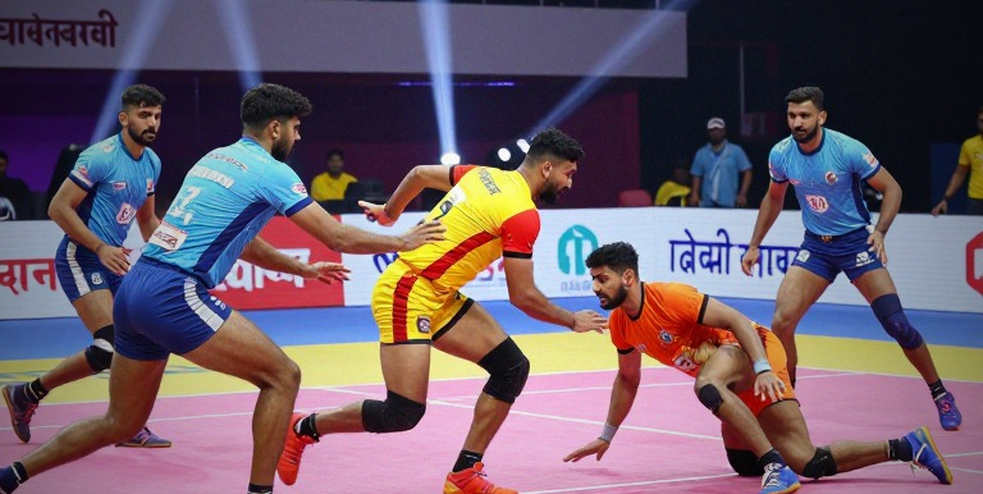
कबड्डी दक्षिण एशिया का एक संपर्क-आधारित टीम खेल है, जिसमें एक रेडर विरोधी पाले में सांस रोककर ('कबड्डी-कबड्डी' कहते हुए) जाकर अंक बनाता है और डिफेंडर उसे रोकते हैं। यह 1990 से पुरुष और 2010 से महिला वर्ग में एशियाई खेलों का आधिकारिक हिस्सा है। खेल के आधुनिक युग की शुरुआत 2014 में प्रो कबड्डी लीग से मानी जाती है, जिसने फ्रैंचाइज़ी मॉडल, टेलीविज़न प्रसारण और पेशेवर खिलाड़ी अर्थव्यवस्था को जन्म दिया। परदीप नरवाल लीग इतिहास के सर्वाधिक रेड अंकों वाले खिलाड़ी हैं और 'डबकी' तकनीक के लिए जाने जाते हैं। अंतरराष्ट्रीय स्तर पर भारत सबसे मज़बूत टीम रहा है, जबकि ईरान पिछले एक दशक में सबसे बड़ा प्रतिद्वंद्वी बनकर उभरा है। खेल की प्रमुख चुनौतियां हैं — खिलाड़ियों की आय में असमानता, छोटा लीग कैलेंडर, चोटों का उच्च जोखिम, और महिला कबड्डी के लिए सीमित लीग मंच।
In the villages of the Indian subcontinent, kabaddi was never just a game — it was the signature of the evening. A harvested field, a patch of flattened earth outside the chaupal, and two teams drawn from the boys of the lane were all it took to start the chant of kabaddi-kabaddi. There was no expensive equipment, no coaching academy, no selection committee. All that was required was the nerve to hold one's breath and step into the opponent's half, and a line drawn between two teams. For decades the sport stayed confined to school tournaments, village fairs, and the grounds of the police and the army. Then, over the last decade, kabaddi's story changed — the way a wrestler from a village akhara is suddenly placed under stadium floodlights.
The shift is generally dated to 2026, when the Pro Kabaddi League played its first season. The question then was whether an indigenous sport, never treated seriously by television, could connect with people through a franchise model built around city teams. The doubt was reasonable: a large share of Indian sports broadcasting belonged to cricket, and prime time did not exist for anything else. Kabaddi bet on something else — the naturalness of recognition. Team jerseys, player names, and the dhol that played at every match together gave the sport a new language. Players who had been known only on the state circuit became household names. The league changed not only broadcast but also player incomes, the standard of coaching, and the culture of fitness. Where players once combined jobs with the sport, a path to live on the sport alone opened up.
The biggest face of that change is Pardeep Narwal. From Narwal village in Sonipat district, Haryana, Pardeep stunned not just opposing defenders but crowds with his dubki — a raid in which the raider slips beneath the body of an incoming tackler. The technique is not easy; it demands pace, timing and body control in exact combination. With Patna Pirates he won title after title and holds the record for the most raid points in the league's history. The measure of his popularity is that a player from a village mud court became the face of advertisements and television conversation.
The generation after him made the sport faster. Naveen Kumar of Dabang Delhi KC redefined raiding with his acceleration and change of direction. Young raiders such as Arjun Deshwal of Jaipur Pink Panthers show that the league is no longer a stage only for established names but a ladder for newcomers. The sport has also changed technically. Rules such as the bonus point, the do-or-die raid and the super tackle have kept matches alive until the final minute. Where teams once played safe to build a margin, every raid now carries risk.
Kabaddi's greatest quality is that attack and defence matter equally. In the league's early years teams depended heavily on raiding, but defensive coaching and video analysis gradually made tackling just as strategic. The clearest example of this shift is the dominance of players from Iran. Defenders such as Fazel Atrachali proved in the Indian league that kabaddi is no longer only India's sport. Young Iranian players such as Mohammadreza Shadloui are now the spine of their teams — a sign of how wide the sport's technical base has grown. The presence of foreign players has also posed a new challenge for domestic players: holding one's place demands constant improvement.
Internationally, kabaddi's story has long revolved around India. Men's kabaddi became an official Asian Games sport in 2026, and since then the Indian team has consistently been the strongest. But in recent years Iran, South Korea and Bangladesh have narrowed the gap sharply. Iran is no longer merely a participant; it is the real contest in every final. Names such as former India captains Ajay Thakur and Anup Kumar symbolise an era when the Indian side had depth of experience; today's challenge is converting that experience into the next generation. The 2026 Kabaddi World Cup was a major step in that direction, showing the sport could be organised as an international tournament. Yet it is also true that at club level no permanent international kabaddi league has taken root, and that remains the biggest gap in the sport's global expansion.
One shift that receives less attention is the growth of women's kabaddi. Women's kabaddi was included in the Asian Games in 2026, and the Indian women's team has been a consistent medal contender since. Participation by girls has clearly risen in states such as Haryana, Maharashtra, Odisha and Tamil Nadu. Yet compared with the men, women players have received neither the same media coverage nor the same platform at league level. Participation has grown in rural areas, but safe playing grounds, women coaches and continuity of tournaments remain the three persistent gaps.
Kabaddi's economic momentum has also been notable. The league drew sponsors, team brand values rose, and stadiums began filling in smaller cities. The fan culture built around teams in Jaipur, Patna, Pune and Delhi is rare in Indian sport. But the speed brings concerns. The biggest is inequality of income — the distance between top players and those on the domestic circuit is wide. The second is the calendar: the league season is compressed into a limited number of weeks, leaving players with little continuous competition and forcing many to find a second source of income in the intervening months. The third and most serious is injury — kabaddi involves direct physical contact and allows little recovery time. Knee, shoulder and ankle injuries shorten careers.
Even so, where kabaddi stands today is close to a miracle. A sport whose inclusion in the Olympics was never even demanded is now a permanent part of the Asian Games and has players in many countries. Its presence in Iran, South Korea, Japan, Kenya and Poland shows that the sport's appeal lies in its simplicity — no expensive equipment, only body, breath and strategy. The question is not how to make kabaddi bigger. The question is how to keep its roots — that village akhara — from drying up.
संबंधित खिलाड़ी
लोकप्रिय/पसंदीदा पुस्तकें
Kabaddi: From Mud Courts to the Global Stage, A Sport's Second Innings2026-11-02
Kabaddi: From Mud Courts to Global Leagues, the Second Innings of a Sport2026-11-01
The Rule Ledger of Kabaddi: Why a Raid Against Three Defenders Is the Costliest Play on the Mat2026-10-29
Kabaddi: From the Mud of the Akhada to Broadcast Graphics — The Complete Story of a Sport2026-10-28
Commonwealth Kabaddi Championship 2026, Day 1: The Points Table Is the Biggest Misreading in the Room2026-10-26
अनुशंसित
The Do-or-Die Maths: India vs Iran Gap Lies in Third-Raid Pressure, Not Raid Points2026-10-29
Kabaddi: From Mud Courts to the Global Stage, A Sport's Second Innings2026-11-02
The Sheet Logged a Win, the Body Logged 26 — India's Real Test Before Uganda2026-10-25
Commonwealth Kabaddi Championship 2026, Day 1: The Points Table Is the Biggest Misreading in the Room2026-10-26
Kabaddi: From Mud Courts to Global Leagues, the Second Innings of a Sport2026-11-01
अनुशंसित
Kabaddi: From Mud Courts to Global Leagues, the Second Innings of a Sport2026-11-01
The Do-or-Die Maths: India vs Iran Gap Lies in Third-Raid Pressure, Not Raid Points2026-10-29
Kabaddi: From Mud Courts to the Global Stage, A Sport's Second Innings2026-11-02
Report Withheld: No Kabaddi Source Material Provided, 3003-Word News Report Cannot Be Grounded2026-10-31
India vs Uganda: Auditing the 46-26 and 45-29 Ledgers, and a Title Still Awaiting Verification2026-10-30
अनुशंसित
Commonwealth Kabaddi Championship 2026, Day 1: The Score Sheet Is Accurate, the Picture Is Not2026-10-25
The Do-or-Die Maths: India vs Iran Gap Lies in Third-Raid Pressure, Not Raid Points2026-10-29
India Beat England 46-26 — and Those 26 Conceded Points Are the Number That Matters Before Uganda2026-10-25
India vs Uganda: Auditing the 46-26 and 45-29 Ledgers, and a Title Still Awaiting Verification2026-10-30
Pakistan's Withdrawal Dulls Commonwealth Kabaddi Championship 2026, India's Dominance Grows Further2026-10-28